
The Rich Young Ruler
The Question
"X.com user: The whole point Jesus was making to the rich man is that you can't get eternal life by works. Have you followed every commandment and given all your money to the poor?"
The Answer
Interesting point about the rich young ruler — Jesus wasn't handing out a checklist to "earn" eternal life by works (we all know Ephesians 2:8-9). But I believe He was doing something even deeper: testing the man's heart to see if he was truly willing to follow Him all the way... even if it cost every last bit of his riches.
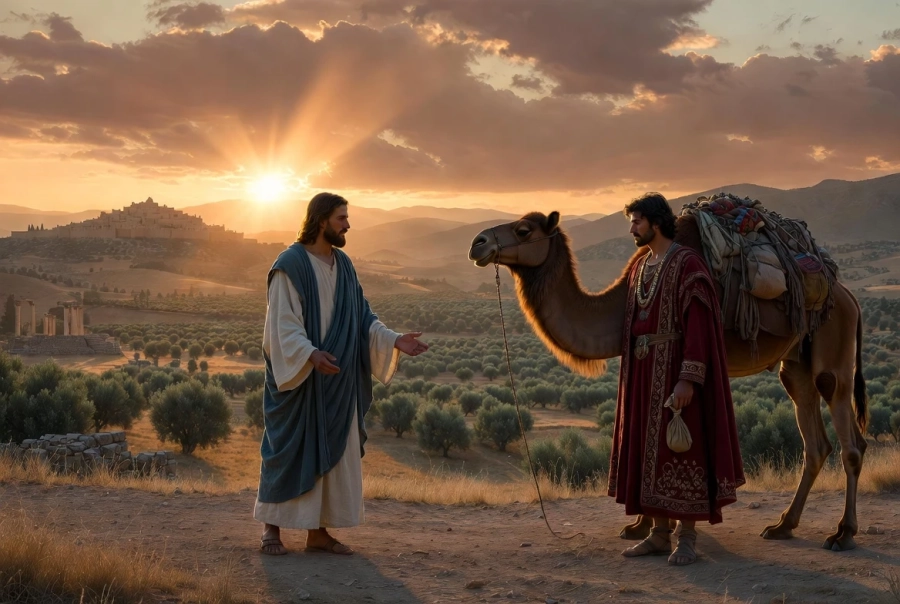
The young man came running, knelt, and asked, "Good Master, what shall I do that I may inherit eternal life?" Jesus listed the commandments (no murder, adultery, stealing, false witness, defraud not, honor parents — basically the 10 Commandments lived out toward others). The man said, "Master, all these have I observed from my youth." Then Jesus, looking at him and loving him, said the famous line: "One thing thou lackest: go thy way, sell whatsoever thou hast, and give to the poor, and thou shalt have treasure in heaven: and come, take up the cross, and follow me."
I don't think Jesus was saying "sell everything or you can't be saved by works." He was testing: Are you willing to follow Me (which means keeping My Father's commandments with your whole heart) even if it means giving up everything that feels like security? Would you release your riches rather than let them pull you into breaking even one commandment?
Because here's what I've seen in the walk with Christ: plenty of folks keep the commandments faithfully for years. They give to the needy, live honest, honor God. Then tragedy hits — sudden loss, homelessness staring them down, friends and family turning away, job gone. The pressure builds: "I need money right now... do I lie on this application? Steal a little to eat? Cut corners at the next opportunity to get ahead?" The world whispers that keeping the commandments will leave you with nothing. Suddenly it's a raw decision: "Do I break them to hold onto what I have, or trust Jesus even when it feels like I'll lose everything?"
That rich young ruler simply hadn't been tested yet. Jesus gave him the test right there: prove it. Show Me your heart is fully Mine, not divided by mammon. (Riches themselves aren't the sin — Abraham, Isaac, Jacob, David, and others had wealth and were blessed. The issue is how we got them, and whether we'd cling to them if holding on meant disobeying God.)Think of Abraham on Mount Moriah (Genesis 22). God tested him: "Take now thy son, thine only son Isaac, whom thou lovest... and offer him." Abraham was willing — he believed God could raise him from the dead if needed. He raised the knife... and God stopped him, provided the ram. Abraham didn't actually lose what mattered most, because his willingness was the point. Jesus was doing the same with the rich man: "Will you follow Me to the end, even if the cost looks total?"
My total point is this: what good is claiming to follow Jesus if we won't follow Him when the stakes are highest? When the fire of real trial comes and the potential loss feels unbearable? " He that endureth to the end shall be saved" (Matthew 10:22). The free gift of eternal life is offered, yes — but true discipleship is proven in those moments where everything in this world says, "Break the commandments just this once to survive."
And only those who have walked that narrow way of full obedience to the 10 Commandments (Jesus' own ways) ever truly understand how costly it is to "lay down our lives for the brethren" (1 John 3:16). It's not theory. It's the daily choice, forged in the heat of loss and pressure, to say: "Not my will, but Thine — even if I lose it all."
One more layer to this, if you’ll indulge me…
Imagine a man who truly believes in God, who sincerely wants to walk righteously, and who is also very wealthy. Where, exactly, is he tempted in daily life to break the 10 Commandments?
Most of the common pressures simply aren’t there.
He has money in abundance — no gnawing desperation that makes a man steal to feed his family.
He already has homes, shelter, food in plenty, and the kind of security that removes the frantic scramble so many face.
Even the pull toward certain sins of passion or compromise is often lessened because the world already offers him companionship, pleasures, and status without him having to violate God’s law to obtain them.
So his righteousness can look very “clean” on the outside for years — he keeps the commandments in comfort. He honors his parents, doesn’t murder or commit adultery, doesn’t bear false witness in court, doesn’t covet his neighbor’s ox or field because he already owns far more. The fire that tests most of us — “Will I lie, steal, or cheat just to survive the next month?” — that fire never touches him.
That’s precisely why Jesus zeroed in on his great possessions with laser focus. The rich young ruler had never been tested in the one area where his heart was actually vulnerable: would he still obey and follow the Lord if keeping the commandments meant releasing the very thing that had shielded him from every other test?
We see the same pattern throughout Scripture. Abraham was wealthy and blessed, yet God tested him by asking for Isaac — the one thing that mattered most. Job was “the greatest of all the men of the east,” full of riches and integrity, yet when everything was stripped away in a single day, his obedience was proven in the furnace of loss: “The Lord gave, and the Lord hath taken away; blessed be the name of the Lord.” He refused to sin with his lips or turn from righteousness.
The point isn’t that wealth is automatically sinful. The point is that comfort can hide the true allegiance of the heart. A wealthy man who wants to follow Jesus may go decades without facing the raw choice so many poorer believers face daily: “Do I break the commandments right now to keep what little I have… or do I trust and obey even when it feels like everything will be lost?”
Jesus loved that rich young ruler enough to give him the test in advance. “Let’s see if your righteousness will hold when I ask you to lay down the very thing that has protected you from every other temptation.”
That’s the question every one of us who claims to follow Him will eventually face — in prosperity or in sudden tragedy. Will we still follow to the end when the cost is real and the buffer is gone?
One more angle on this
The men and women who actually follow the 10 Commandments even when it costs them everything — their finances, their comfort, sometimes their very livelihood — these are the very “poor” Jesus had in mind when He told the rich man, “Sell whatsoever thou hast, and give to the poor.”
Think about it: how often can you truthfully call a genuinely poor man a thief? If he were stealing, where are his riches? Where is the stash? Where is the evidence of the dishonest gain? The man who refuses to lie on his taxes, refuses to pad his hours, refuses to cheat his customers, refuses to take what isn’t his even when he’s staring at eviction or empty cupboards — that man has already proven where his treasure is. He chose obedience over security. He chose light over darkness when the cost was real.
Now picture two people who both used to have money and comfort. Both say they’re struggling now.
One pulls up in a Mercedes, still dressed sharp, still living large.
The other shows up on a bicycle, clothes worn, shoes thin, but eyes clear and conscience clean.
Which one has demonstrated — with his actual life — that he refused to steal, lie, or compromise to keep his riches?
Which one chose the narrow way when the pressure came and the world said, “Just bend the commandments this once and you’ll stay afloat”?
Many will quickly say, “Well the guy on the bike obviously didn’t invest wisely or manage his money well, or he has hidden sin.. (Think Job)”
But that isn’t always the case — not by a long shot. Sometimes the bike rider is the one who said, “I will not defraud, I will not bear false witness, I will not steal — even if it means I lose it all.” And the Lord allowed the test to come. That is the righteous poor. That is the brother or sister Jesus is pointing to when He says, “Inasmuch as ye have done it unto one of the least of these My brethren, ye have done it unto Me.”
The rich young ruler was being invited to join that company — to become one who gives to those very people because he himself would have walked in their shoes if necessary. Jesus wasn’t just telling him to redistribute wealth; He was telling him to step into the same costly obedience that marks the true poor in the kingdom.
So when we give, let it be with eyes wide open. Let it flow toward the ones whose poverty is the fruit of their faithfulness, not the fruit of laziness or foolishness. Those are the ones carrying the weight of real discipleship — the ones who have already counted the cost and said, “I will follow Him to the end, no matter what it takes.”
That’s the kind of giving that stores up treasure in heaven. That’s the kind of poor the Master is looking for us to help.
One more step deeper into this
Only after a man has actually followed the 10 Commandments even when it cost him everything — his finances, his reputation, his future security — does he finally begin to understand the weight of Jesus’ teachings on mercy, on not judging by appearances, on true compassion.
Picture this scene (it plays out more often than we admit):
A brother who has walked in costly obedience for years now sits in a hotel room with just enough for tonight. Tomorrow the bill is due and there is nothing left. He reaches out — not to the world, but to fellow believers, even those who have known him for decades and watched him labor faithfully. Instead of mercy, he meets suspicion: “You must be faking it… or lazy… or mismanaging.” The very people who once praised his diligence now look at his worn clothes, his bicycle, his empty hands, and judge by what they see on the surface. They abandon him. They turn the situation back on him as though his obedience somehow proves he is at fault.
In that moment the veil is ripped away. He realizes: these comfortable ones cannot see what he now sees. Their wealth and ease have shielded them from ever facing the raw choice he faced daily: “Will I break even one commandment to avoid this discomfort?” They would, in a heartbeat, lie, cut corners, defraud, or steal “just this once” if it meant keeping their lifestyle intact. Their righteousness has never been tested by fire. It has only been lived in the greenhouse of prosperity.
And Jesus warned exactly about this kind of person:
“Not every one that saith unto me, Lord, Lord, shall enter into the kingdom of heaven… Many will say to me in that day, Lord, Lord, have we not prophesied in thy name… and then will I profess unto them, I never knew you: depart from me, ye that work iniquity.”
Iniquity = lawlessness = living as though the commandments are optional when the cost gets personal.
It is easy to talk about “being poor and destitute, or how one would work their way out of it” when you are doing it from a warm house with a full pantry and a safety net. It is something entirely different to be there — truly there — with the rent due and the phone silent. Only the one who has walked the narrow way through that valley truly grasps why Jesus said, “Judge not according to the appearance, but judge righteous judgment.” Only he understands the depth of “Blessed are the merciful, for they shall obtain mercy.” Because he has seen how quickly the comfortable can become the accusers.
The enemy (not some cartoon with horns and a pitchfork, but real flesh-and-blood people moving under his influence) is always prowling, ready to use those very “brethren” to wound the faithful one who refused to compromise.
This is the deeper invitation Jesus extended to the rich young ruler: “Come, sell it all, give to the poor who have already proven their obedience in the furnace, and join them in the school of real mercy and real sight.” Only then do you begin to see as Jesus sees.
Just to be perfectly clear right up front: When I use the word “you” in the examples, I’m only speaking in the general, abstract sense — like saying “a person” or “anyone walking this path” — not meaning you personally at all. It’s simply the most vivid way to describe what so many faithful believers face. Hope that lands well and removes any chance of misunderstanding.
Going even one layer deeper still
When a man has already walked in costly obedience to the 10 Commandments and now finds himself in that place of real desperation — pressure mounting, options gone, the future looking dark — the mind can still scramble for one last “solution.”
Suddenly the thought flashes:
"I GOT IT. I can get out of this mess. I’ll steal from my enemies… or from people I deem bad or evil or corrupt. They deserve it anyway! I’m not hurting innocent people — I’m just taking from the wicked who have it coming!”
For a moment it almost feels righteous. Justified. Clever, even.
Oh wait… I can’t do that either.
Because “Thou shalt not steal” has no footnotes. No exceptions. No special clause that says “unless the victim is your enemy” or “unless they’re evil” or “unless you’re truly desperate.” The commandment is absolute — full stop.
Jesus never gave us a loophole. In fact He raised the standard even higher: “Love your enemies, bless them that curse you, do good to them that hate you, and pray for them which despitefully use you.” Vengeance is the Lord’s, not ours. “Recompense to no man evil for evil.”
This is where the test goes all the way to the bone. This is part of what Jesus was probing so deeply in the rich young ruler: not just “sell what you have and give to the poor,” but “will your heart follow Me with zero back doors — even when your flesh offers the most ‘justified’ sin of all?”
Only the one who has slammed shut every single rationalization — the obvious ones and the clever “righteous” ones — truly begins to understand what it means to follow Jesus to the end with an undivided heart.
The narrow way is narrower than most of us want to admit… but it is the only way that leads to life.
Another layer deeper still.
Now we can truly begin to understand the children of Israel right after they left Egypt.
Fresh out of bondage, they had followed Moses through the Red Sea — the old life of “comfortable slavery” behind them. No more fleshpots of Egypt, no more easy onions and leeks. Just the wilderness, daily manna, and the unrelenting call to keep walking in God’s commandments when every step looked like death.
And they said of Moses exactly what so many feel in the heat of costly obedience:
“He has led us out here to die!”
They looked at the barren ground, the hunger, the uncertainty, and cried out, “Would to God we had died by the hand of the Lord in the land of Egypt… for ye have brought us forth into this wilderness, to kill this whole assembly with hunger!”
Then, when the pressure became unbearable, many turned back in their hearts: “Up, make us gods which shall go before us!” — and they fell down and worshipped the golden calf.
Following the 10 Commandments even to our own detriment can feel exactly like that wilderness journey.
You’ve left the “Egypt” of compromise and self-preservation. Now you’re in the place where keeping every single commandment — no stealing, no lying, no coveting, no shortcuts — means real loss, real emptiness, real pressure that makes the soul cry, “This is going to kill me!” The flesh and the enemy whisper, “Go back! Worship the old gods of quick relief! Do whatever it takes to survive!”
And here is the sobering part the Lord keeps pressing on my heart:
Many will not make it to the Promised Land.
Just as that first generation fell in the wilderness because their hearts turned back to Egypt, Jesus warned the same narrow road: “Strait is the gate, and narrow is the way, which leadeth unto life, and few there be that find it.”
The rich young ruler stood right at the entrance to that wilderness — “Sell all, give to the poor, take up the cross, and follow Me” — and he went away sorrowful. He chose Egypt over the promise.
This is why the test is so fierce. Costly obedience is the wilderness that separates those who will inherit the promises from those who only tasted the beginning.
One more layer deeper still — and this one ties it all together.
Jesus didn’t hide the cost of discipleship. Right after the rich young ruler walked away sorrowful (because he couldn’t pay the price), the Lord turned to the crowd and laid it out plainly:“
For which of you, intending to build a tower, sitteth not down first, and counteth the cost, whether he have sufficient to finish it? … Or what king, going to make war against another king, sitteth not down first, and consulteth whether he be able with ten thousand to meet him that cometh against him with twenty thousand? … So likewise, whosoever he be of you that forsaketh not all that he hath, he cannot be my disciple.” (Luke 14:28-33)He even said earlier: “If any man come to me, and hate not his father, and mother, and wife, and children, and brethren, and sisters, yea, and his own life also, he cannot be my disciple. And whosoever doth not bear his cross, and come after me, cannot be my disciple.” (Luke 14:26-27)If it were just “believe in His name and you’re good,” there would be zero cost. Anyone can mentally assent. Anyone can say “Lord, Lord.” But following — truly serving Jesus and walking in the Father’s commandments — that always costs something real. And for many, the heaviest part of that cost comes straight out of our coffers.
The rich young ruler had already kept the commandments outwardly, but when Jesus said, “Sell all thou hast, and give to the poor… and come, follow me,” the man suddenly saw the bill. The true price wasn’t belief. It was surrender. It was releasing the very thing that had shielded him from ever having to choose between comfort and obedience.
That’s why Jesus immediately followed it with the “count the cost” teaching. He was saying: “Don’t start this journey unless you’re willing to pay in full — even if it empties your bank account, empties your storehouses, empties your sense of security.”
The cost isn’t optional for disciples. It’s the proof that our treasure really is in heaven and not on earth. It’s the difference between the wide gate (easy belief with no change) and the narrow way (costly obedience that actually follows).This is why so many turn back in the wilderness like the Israelites did. They counted the cost… and decided it was too high. But those who pay it — who let it come out of their coffers, out of their comfort, out of their very lives — those are the ones who will hear, “Well done, thou good and faithful servant… enter thou into the joy of thy Lord.”
Let me put it another way
James Hardie offers a superior siding product that guarantees many years of beauty and zero weather penetration for your home. (That’s the great product — like the free gift of eternal life.)It comes with an amazing 50+ year warranty that promises to replace or repair anything that fails. (That’s the warranty — God’s unbreakable promise.)
But it also comes with very specific installation instructions: exact nailing patterns, proper flashing behind every gap, starting from the bottom up, etc. (That’s the manual — the 10 Commandments and the way of Jesus.)
Now ask yourself:
Who can honestly say, “I have the James Hardie warranty” when they never actually installed the siding on their house?
Who can demand that James Hardie honor the warranty if they installed it their own way — ignoring the recommended nailing schedule and skipping the flashing?
And who can say, “I just believe in James Hardie,” having never put the product on their home at all… and still expect their house to be safe when the storms come?
When the storms finally hit and you call James Hardie to honor the warranty, but you never installed it properly — or never installed it at all — you will likely hear them say: “Depart from me, I never knew you.”
The product and the warranty are real and free… but they only benefit the one who actually follows the instructions.
That’s the heart of what Jesus offers us. What do you think?
The other side of obedience
I’ve spent enough time on the doom and gloom. Now let’s point to the beautiful side of Jesus’ teachings — the many commands and promises He gave specifically so we can help and lift up one another when we are down for following the 10 Commandments.
Jesus knew the narrow way would sometimes leave people poor, rejected, or in real need. So He built real support into His kingdom:
- Right after the rich young ruler walked away, Jesus promised those who leave everything for Him: “There is no man that hath left house, or brethren, or sisters… for my sake, and the gospel’s, But he shall receive an hundredfold now in this time, houses, and brethren, and sisters…” (Mark 10:29-30). The church becomes the new family that steps in and helps!
- “When thou makest a dinner or a supper, call not thy friends… but when thou makest a feast, call the poor, the maimed, the lame, the blind… for they cannot recompense thee: for thou shalt be recompensed at the resurrection of the just.” (Luke 14:12-14). He specifically told us to bless the righteous poor who have lost much for obedience.
- “For I was an hungred, and ye gave me meat: I was thirsty, and ye gave me drink: I was a stranger, and ye took me in: Naked, and ye clothed me: I was sick, and ye visited me: I was in prison, and ye came unto me… Inasmuch as ye have done it unto one of the least of these my brethren, ye have done it unto me.” (Matthew 25:35-40). This is how we serve Jesus Himself — by helping the faithful who are suffering for keeping His commandments.
- “A new commandment I give unto you, That ye love one another; as I have loved you, that ye also love one another. By this shall all men know that ye are my disciples.” (John 13:34-35)
- “Give to every man that asketh of thee… Be ye therefore merciful, as your Father also is merciful… Give, and it shall be given unto you; good measure, pressed down, and shaken together…” (Luke 6:30-38)
- And the Good Samaritan (Luke 10) shows us exactly how to treat the one who has been beaten down on the road of life.
This is the other side of costly obedience — Jesus calls us not only to walk the narrow way, but to carry one another when the load gets heavy.
What do you think about this side of it?
Home > Articles > The Rich Young Ruler
